Calculus Companion
$199.00
This product is currently sold out.



Calculus
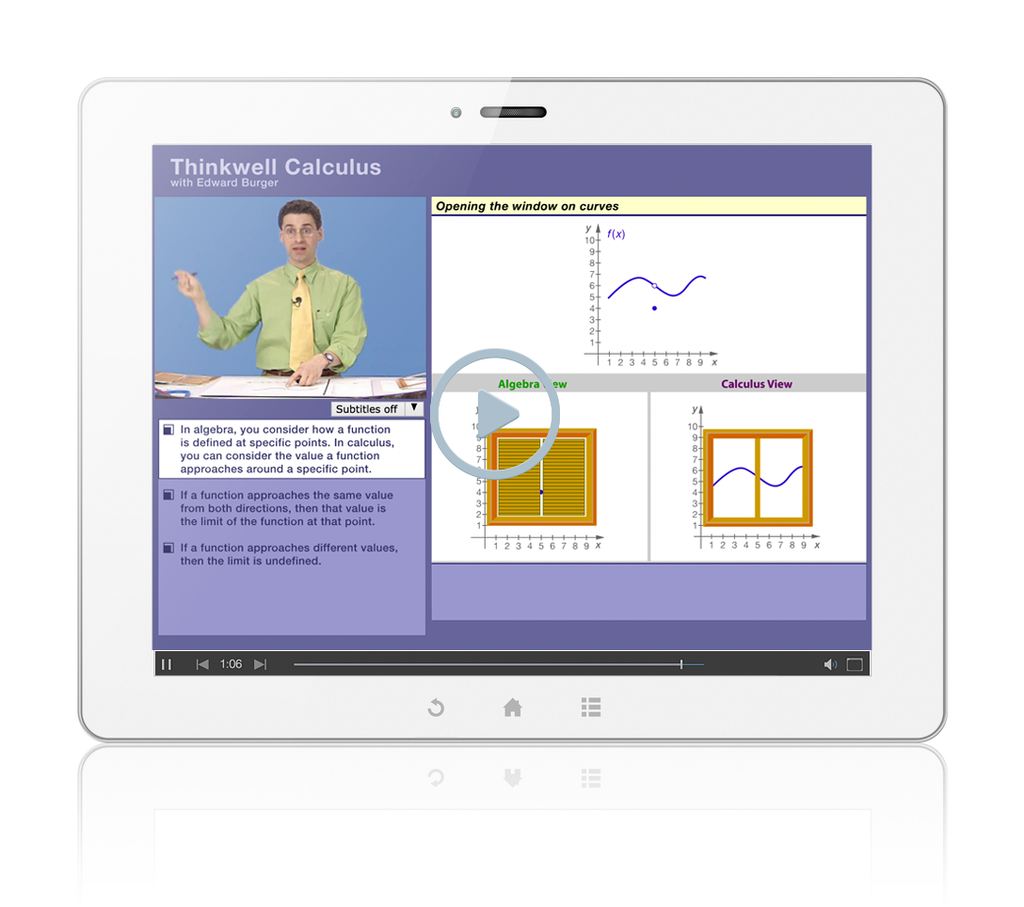
Calculus is advanced math for the high school student, but it's the starting point for math in the most selective colleges and universities. Thinkwell's Calculus course covers both Calculus I and Calculus II, each of which is a one-semester course in college. If you plan to take the AP® Calculus AB or AP® Calculus BC exam, you should consider our Calculus for AP® courses, which have assessments targeted to the AP® exam.
Thinkwell's award-winning math professor, Edward Burger, has a gift for explaining and demonstrating the underlying structure of calculus so that your students will retain what they've learned. It's a great head start for the college-bound math, science, or engineering student.
Thinkwell Calculus is approved by the University of California and on their A-G course list.
Our complete Calculus package includes:- 12-month Online Subscription to our complete Calculus course with video lessons, automatically graded calculus problems, and much more.
- Printed Notes (optional) are the Calculus course notes from the Online Subscription printed in a color, on-the-go format.
Calculus Materials
Online Subscription, 12-month access
Access to a complete online package that includes everything you need:
- High-quality video lessons explain all of the Calculus math topics and concepts
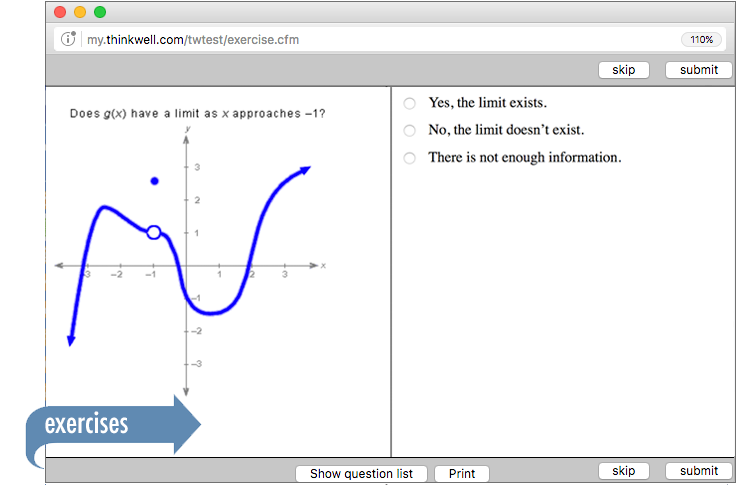
- Automatically graded calculus problems with immediate feedback allow you to track your progress
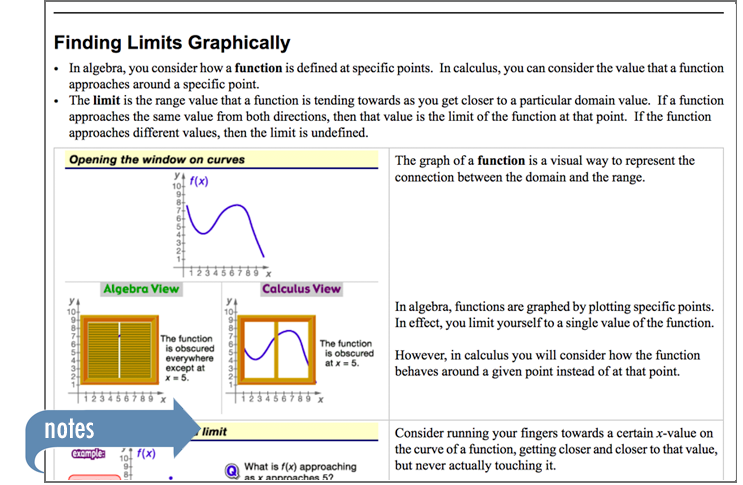
- Printable full-color illustrated notes help you review what you've learned in the video lesson
- Subscriptions start when you are ready. Buy now and activate your course anytime you like. Wait up to one year to activate your subscription; your 12-month subscription doesn't begin until you say so!
Calculus Details
Thinkwell's Calculus has all the features your home school needs:
- More than 270 educational video lessons
- 2000+ interactive calculus exercises with immediate feedback allow you to track your progress
- Automatically graded calculus tests for all 21 chapters, as well as practice tests, a midterm, and a final examPrintable illustrated notes for each topic
- Real-world application examples in both lectures and exercises
- Interactive animations with audio
- Glossary of more than 450 mathematical terms
- Engaging content to help students advance their mathematical knowledge:
- Limits and derivatives
- Computational techniques such as the power rule, product rule, quotient rule, and chain rule
- Differentiation, optimization, and related rates
- Antiderivatives, integration, and the fundamental theorem of calculus
- Indeterminate forms and L'Hopital's rule
- Sequences and series
- Differential equations
- Parametric equations and polar coordinates
- Vector calculus
Table of Contents
1. The Basics
- 1.1 Overview
- 1.1.1 An Introduction to Thinkwell Calculus
- 1.1.2 The Two Questions of Calculus
- 1.1.3 Average Rates of Change
- 1.1.4 How to Do Math
- 1.2 Precalculus Review
- 1.2.1 Functions
- 1.2.2 Graphing Lines
- 1.2.3 Parabolas
- 1.2.4 Some Non-Euclidean Geometry
2. Limits
- 2.1 The Concept of the Limit
- 2.1.1 Finding Rate of Change over an Interval
- 2.1.2 Finding Limits Graphically
- 2.1.3 The Formal Definition of a Limit
- 2.1.4 The Limit Laws, Part I
- 2.1.5 The Limit Laws, Part II
- 2.1.6 One-Sided Limits
- 2.1.7 The Squeeze Theorem
- 2.1.8 Continuity and Discontinuity
- 2.2 Evaluating Limits
- 2.2.1 Evaluating Limits
- 2.2.2 Limits and Indeterminate Forms
- 2.2.3 Two Techniques for Evaluating Limits
- 2.2.4 An Overview of Limits
3. An Introduction to Derivatives
- 3.1 Understanding the Derivative
- 3.1.1 Rates of Change, Secants, and Tangents
- 3.1.2 Finding Instantaneous Velocity
- 3.1.3 The Derivative
- 3.1.4 Differentiability
- 3.2 Using the Derivative
- 3.2.1 The Slope of a Tangent Line
- 3.2.2 Instantaneous Rate
- 3.2.3 The Equation of a Tangent Line
- 3.2.4 More on Instantaneous Rate
- 3.3 Some Special Derivatives
- 3.3.1 The Derivative of the Reciprocal Function
- 3.3.2 The Derivative of the Square Root Function
4. Computational Techniques
- 4.1 The Power Rule
- 4.1.1 A Shortcut for Finding Derivatives
- 4.1.2 A Quick Proof of the Power Rule
- 4.1.3 Uses of the Power Rule
- 4.2 The Product and Quotient Rules
- 4.2.1 The Product Rule
- 4.2.2 The Quotient Rule
- 4.3 The Chain Rule
- 4.3.1 An Introduction to the Chain Rule
- 4.3.2 Using the Chain Rule
- 4.3.3 Combining Computational Techniques
5. Special Functions
- 5.1 Trigonometric Functions
- 5.1.1 A Review of Trigonometry
- 5.1.2 Graphing Trigonometric Functions
- 5.1.3 The Derivatives of Trigonometric Functions
- 5.1.4 The Number Pi
- 5.2 Exponential Functions
- 5.2.1 Graphing Exponential Functions
- 5.2.2 Derivatives of Exponential Functions
- 5.2.3 The Music of Math
- 5.3 Logarithmic Functions
- 5.3.1 Evaluating Logarithmic Functions
- 5.3.2 The Derivative of the Natural Log Function
- 5.3.3 Using the Derivative Rules with Transcendental Functions
6. Implicit Differentiation
- 6.1 Implicit Differentiation Basics
- 6.1.1 An Introduction to Implicit Differentiation
- 6.1.2 Finding the Derivative Implicitly
- 6.2 Applying Implicit Differentiation
- 6.2.1 Using Implicit Differentiation
- 6.2.2 Applying Implicit Differentiation
7. Applications of Differentiation
- 7.1 Position and Velocity
- 7.1.1 Acceleration and the Derivative
- 7.1.2 Solving Word Problems Involving Distance and Velocity
- 7.2 Linear Approximation
- 7.2.1 Higher-Order Derivatives and Linear Approximation
- 7.2.2 Using the Tangent Line Approximation Formula
- 7.2.3 Newton's Method
- 7.3 Related Rates
- 7.3.1 The Pebble Problem
- 7.3.2 The Ladder Problem
- 7.3.3 The Baseball Problem
- 7.3.4 The Blimp Problem
- 7.3.5 Math Anxiety
- 7.4 Optimization
- 7.4.1 The Connection Between Slope and Optimization
- 7.4.2 The Fence Problem
- 7.4.3 The Box Problem
- 7.4.4 The Can Problem
- 7.4.5 The Wire-Cutting Problem
8. Curve Sketching
- 8.1 Introduction
- 8.1.1 An Introduction to Curve Sketching
- 8.1.2 Three Big Theorems
- 8.1.3 Morale Moment
- 8.2 Critical Points
- 8.2.1 Critical Points
- 8.2.2 Maximum and Minimum
- 8.2.3 Regions Where a Function Increases or Decreases
- 8.2.4 The First Derivative Test
- 8.2.5 Math Magic
- 8.3 Concavity
- 8.3.1 Concavity and Inflection Points
- 8.3.2 Using the Second Derivative to Examine Concavity
- 8.3.3 The Möbius Band
- 8.4 Graphing Using the Derivative
- 8.4.1 Graphs of Polynomial Functions
- 8.4.2 Cusp Points and the Derivative
- 8.4.3 Domain-Restricted Functions and the Derivative
- 8.4.4 The Second Derivative Test
- 8.5 Asymptotes
- 8.5.1 Vertical Asymptotes
- 8.5.2 Horizontal Asymptotes and Infinite Limits
- 8.5.3 Graphing Functions with Asymptotes
- 8.5.4 Functions with Asymptotes and Holes
- 8.5.5 Functions with Asymptotes and Critical Points
9. The Basics of Integration
- 9.1 Antiderivatives
- 9.1.1 Antidifferentiation
- 9.1.2 Antiderivatives of Powers of x
- 9.1.3 Antiderivatives of Trigonometric and Exponential Functions
- 9.2 Integration by Substitution
- 9.2.1 Undoing the Chain Rule
- 9.2.2 Integrating Polynomials by Substitution
- 9.3 Illustrating Integration by Substitution
- 9.3.1 Integrating Composite Trigonometric Functions by Substitution
- 9.3.2 Integrating Composite Exponential and Rational Functions by Substitution
- 9.3.3 More Integrating Trigonometric Functions by Substitution
- 9.3.4 Choosing Effective Function Decompositions
- 9.4 The Fundamental Theorem of Calculus
- 9.4.1 Approximating Areas of Plane Regions
- 9.4.2 Areas, Riemann Sums, and Definite Integrals
- 9.4.3 The Fundamental Theorem of Calculus, Part I
- 9.4.4 The Fundamental Theorem of Calculus, Part II
- 9.4.5 Illustrating the Fundamental Theorem of Calculus
- 9.4.6 Evaluating Definite Integrals
10. Applications of Integration
- 10.1 Motion
- 10.1.1 Antiderivatives and Motion
- 10.1.2 Gravity and Vertical Motion
- 10.1.3 Solving Vertical Motion Problems
- 10.2 Finding the Area between Two Curves
- 10.2.1 The Area between Two Curves
- 10.2.2 Limits of Integration and Area
- 10.2.3 Common Mistakes to Avoid When Finding Areas
- 10.2.4 Regions Bound by Several Curves
- 10.3 Integrating with Respect to y
- 10.3.1 Finding Areas by Integrating with Respect to y: Part One
- 10.3.2 Finding Areas by Integrating with Respect to y: Part Two
- 10.3.3 Area, Integration by Substitution, and Trigonometry
11. Calculus I Review
- 11.1 The Close of Calculus I
- 11.1.1 A Glimpse Into Calculus II
12. Math Fun
- 12.1 Paradoxes
- 12.1.1 An Introduction to Paradoxes
- 12.1.2 Paradoxes and Air Safety
- 12.1.3 Newcomb's Paradox
- 12.1.4 Zeno's Paradox
- 12.2 Sequences
- 12.2.1 Fibonacci Numbers
- 12.2.2 The Golden Ratio
13. An Introduction to Calculus II
- 13.1 Introduction
- 13.1.1 Welcome to Calculus II
- 13.1.2 Review: Calculus I in 20 Minutes
14. L'Hôpital's Rule
- 14.1 Indeterminate Quotients
- 14.1.1 Indeterminate Forms
- 14.1.2 An Introduction to L'Hôpital's Rule
- 14.1.3 Basic Uses of L'Hôpital's Rule
- 14.1.4 More Exotic Examples of Indeterminate Forms
- 14.2 Other Indeterminate Forms
- 14.2.1 L'Hôpital's Rule and Indeterminate Products
- 14.2.2 L'Hôpital's Rule and Indeterminate Differences
- 14.2.3 L'Hôpital's Rule and One to the Infinite Power
- 14.2.4 Another Example of One to the Infinite Power
15. Elementary Functions and Their Inverses
- 15.1 Inverse Functions
- 15.1.1 The Exponential and Natural Log Functions
- 15.1.2 Differentiating Logarithmic Functions
- 15.1.3 Logarithmic Differentiation
- 15.1.4 The Basics of Inverse Functions
- 15.1.5 Finding the Inverse of a Function
- 15.2 The Calculus of Inverse Functions
- 15.2.1 Derivatives of Inverse Functions
- 15.3 Inverse Trigonometric Functions
- 15.3.1 The Inverse Sine, Cosine, and Tangent Functions
- 15.3.2 The Inverse Secant, Cosecant, and Cotangent Functions
- 15.3.3 Evaluating Inverse Trigonometric Functions
- 15.4 The Calculus of Inverse Trigonometric Functions
- 15.4.1 Derivatives of Inverse Trigonometric Functions
- 15.4.2 More Calculus of Inverse Trigonometric Functions
- 15.5 The Hyperbolic Functions
- 15.5.1 Defining the Hyperbolic Functions
- 15.5.2 Hyperbolic Identities
- 15.5.3 Derivatives of Hyperbolic Functions
16. Techniques of Integration
- 16.1 Integration Using Tables
- 16.1.1 An Introduction to the Integral Table
- 16.1.2 Making u-Substitutions
- 16.2 Integrals Involving Powers of Sine and Cosine
- 16.2.1 An Introduction to Integrals with Powers of Sine and Cosine
- 16.2.2 Integrals with Powers of Sine and Cosine
- 16.2.3 Integrals with Even and Odd Powers of Sine and Cosine
- 16.3 Integrals Involving Powers of Other Trigonometric Functions
- 16.3.1 Integrals of Other Trigonometric Functions
- 16.3.2 Integrals with Odd Powers of Tangent and Any Power of Secant
- 16.3.3 Integrals with Even Powers of Secant and Any Power of Tangent
- 16.4 An Introduction to Integration by Partial Fractions
- 16.4.1 Finding Partial Fraction Decompositions
- 16.4.2 Partial Fractions
- 16.4.3 Long Division
- 16.5 Integration by Partial Fractions with Repeated Factors
- 16.5.1 Repeated Linear Factors: Part One
- 16.5.2 Repeated Linear Factors: Part Two
- 16.5.3 Distinct and Repeated Quadratic Factors
- 16.5.4 Partial Fractions of Transcendental Functions
- 16.6 Integration by Parts
- 16.6.1 An Introduction to Integration by Parts
- 16.6.2 Applying Integration by Parts to the Natural Log Function
- 16.6.3 Inspirational Examples of Integration by Parts
- 16.6.4 Repeated Application of Integration by Parts
- 16.6.5 Algebraic Manipulation and Integration by Parts
- 16.7 An Introduction to Trigonometric Substitution
- 16.7.1 Converting Radicals into Trigonometric Expressions
- 16.7.2 Using Trigonometric Substitution to Integrate Radicals
- 16.7.3 Trigonometric Substitutions on Rational Powers
- 16.8 Trigonometric Substitution Strategy
- 16.8.1 An Overview of Trigonometric Substitution Strategy
- 16.8.2 Trigonometric Substitution Involving a Definite Integral: Part One
- 16.8.3 Trigonometric Substitution Involving a Definite Integral: Part Two
- 16.9 Numerical Integration
- 16.9.1 Deriving the Trapezoidal Rule
- 16.9.2 An Example of the Trapezoidal Rule
17. Improper Integrals
- 17.1 Improper Integrals
- 17.1.1 The First Type of Improper Integral
- 17.1.2 The Second Type of Improper Integral
- 17.1.3 Infinite Limits of Integration, Convergence, and Divergence
18. Applications of Integral Calculus
- 18.1 The Average Value of a Function
- 18.1.1 Finding the Average Value of a Function
- 18.2 Finding Volumes Using Cross-Sections
- 18.2.1 Finding Volumes Using Cross-Sectional Slices
- 18.2.2 An Example of Finding Cross-Sectional Volumes
- 18.3 Disks and Washers
- 18.3.1 Solids of Revolution
- 18.3.2 The Disk Method along the y-Axis
- 18.3.3 A Transcendental Example of the Disk Method
- 18.3.4 The Washer Method across the x-Axis
- 18.3.5 The Washer Method across the y-Axis
- 18.4 Shells
- 18.4.1 Introducing the Shell Method
- 18.4.2 Why Shells Can Be Better Than Washers
- 18.4.3 The Shell Method: Integrating with Respect to y
- 18.5 Arc Lengths and Functions
- 18.5.1 An Introduction to Arc Length
- 18.5.2 Finding Arc Lengths of Curves Given by Functions
- 18.6 Work
- 18.6.1 An Introduction to Work
- 18.6.2 Calculating Work
- 18.6.3 Hooke's Law
- 18.7 Moments and Centers of Mass
- 18.7.1 Center of Mass
- 18.7.2 The Center of Mass of a Thin Plate
19. Sequences and Series
- 19.1 Sequences
- 19.1.1 The Limit of a Sequence
- 19.1.2 Determining the Limit of a Sequence
- 19.1.3 The Squeeze and Absolute Value Theorems
- 19.2 Monotonic and Bounded Sequences
- 19.2.1 Monotonic and Bounded Sequences
- 19.3 Infinite Series
- 19.3.1 An Introduction to Infinite Series
- 19.3.2 The Summation of Infinite Series
- 19.3.3 Geometric Series
- 19.3.4 Telescoping Series
- 19.4 Convergence and Divergence
- 19.4.1 Properties of Convergent Series
- 19.4.2 The nth-Term Test for Divergence
- 19.5 The Integral Test
- 19.5.1 An Introduction to the Integral Test
- 19.5.2 Examples of the Integral Test
- 19.5.3 Using the Integral Test
- 19.5.4 Defining p-Series
- 19.6 The Direct Comparison Test
- 19.6.1 An Introduction to the Direct Comparison Test
- 19.6.2 Using the Direct Comparison Test
- 19.7 The Limit Comparison Test
- 19.7.1 An Introduction to the Limit Comparison Test
- 19.7.2 Using the Limit Comparison Test
- 19.7.3 Inverting the Series in the Limit Comparison Test
- 19.8 The Alternating Series
- 19.8.1 Alternating Series
- 19.8.2 The Alternating Series Test
- 19.8.3 Estimating the Sum of an Alternating Series
- 19.9 Absolute and Conditional Convergences
- 19.9.1 Absolute and Conditional Convergence
- 19.10 The Ratio and Root Tests
- 19.10.1 The Ratio Test
- 19.10.2 Examples of the Ratio Test
- 19.10.3 The Root Test
- 19.11 Polynomial Approximations of Elementary Functions
- 19.11.1 Polynomial Approximation of Elementary Functions
- 19.11.2 Higher-Degree Approximations
- 19.12 Taylor and Maclaurin Polynomials
- 19.12.1 Taylor Polynomials
- 19.12.2 Maclaurin Polynomials
- 19.12.3 The Remainder of a Taylor Polynomial
- 19.12.4 Approximating the Value of a Function
- 19.13 Taylor and Maclaurin Series
- 19.13.1 Taylor Series
- 19.13.2 Examples of the Taylor and Maclaurin Series
- 19.13.3 New Taylor Series
- 19.13.4 The Convergence of Taylor Series
- 19.14 Power Series
- 19.14.1 The Definition of Power Series
- 19.14.2 The Interval and Radius of Convergence
- 19.14.3 Finding the Interval and Radius of Convergence: Part One
- 19.14.4 Finding the Interval and Radius of Convergence: Part Two
- 19.14.5 Finding the Interval and Radius of Convergence: Part Three
- 19.15 Power Series Representations of Functions
- 19.15.1 Differentiation and Integration of Power Series
- 19.15.2 Finding Power Series Representations by Differentiation
- 19.15.3 Finding Power Series Representations by Integration
- 19.15.4 Integrating Functions Using Power Series
20. Differential Equations
- 20.1 Separable Differential Equations
- 20.1.1 An Introduction to Differential Equations
- 20.1.2 Solving Separable Differential Equations
- 20.1.3 Finding a Particular Solution
- 20.1.4 Direction Fields
- 20.2 Solving a Homogeneous Differential Equation
- 20.2.1 Separating Homogeneous Differential Equations
- 20.2.2 Change of Variables
- 20.3 Growth and Decay Problems
- 20.3.1 Exponential Growth
- 20.3.2 Radioactive Decay
- 20.4 Solving First-Order Linear Differential Equations
- 20.4.1 First-Order Linear Differential Equations
- 20.4.2 Using Integrating Factors
21. Parametric Equations and Polar Coordinates
- 21.1 Understanding Parametric Equations
- 21.1.1 An Introduction to Parametric Equations
- 21.1.2 The Cycloid
- 21.1.3 Eliminating Parameters
- 21.2 Calculus and Parametric Equations
- 21.2.1 Derivatives of Parametric Equations
- 21.2.2 Graphing the Elliptic Curve
- 21.2.3 The Arc Length of a Parameterized Curve
- 21.2.4 Finding Arc Lengths of Curves Given by Parametric Equations
- 21.3 Understanding Polar Coordinates
- 21.3.1 The Polar Coordinate System
- 21.3.2 Converting between Polar and Cartesian Forms
- 21.3.3 Spirals and Circles
- 21.3.4 Graphing Some Special Polar Functions
- 21.4 Polar Functions and Slope
- 21.4.1 Calculus and the Rose Curve
- 21.4.2 Finding the Slopes of Tangent Lines in Polar Form
- 21.5 Polar Functions and Area
- 21.5.1 Heading toward the Area of a Polar Region
- 21.5.2 Finding the Area of a Polar Region: Part One
- 21.5.3 Finding the Area of a Polar Region: Part Two
- 21.5.4 The Area of a Region Bounded by Two Polar Curves: Part One
- 21.5.5 The Area of a Region Bounded by Two Polar Curves: Part Two
22. Vector Calculus and the Geometry of R2 and R3
- 22.1 Vectors and the Geometry of R2 and R3
- 22.1.1 Coordinate Geometry in Three-Dimensional Space
- 22.1.2 Introduction to Vectors
- 22.1.3 Vectors in R2 and R3
- 22.1.4 An Introduction to the Dot Product
- 22.1.5 Orthogonal Projections
- 22.1.6 An Introduction to the Cross Product
- 22.1.7 Geometry of the Cross Product
- 22.1.8 Equations of Lines and Planes in R3
- 22.2 Vector Functions
- 22.2.1 Introduction to Vector Functions
- 22.2.2 Derivatives of Vector Functions
- 22.2.3 Vector Functions: Smooth Curves
- 22.2.4 Vector Functions: Velocity and Acceleration
About the Author

Edward Burger is an award-winning professor with a passion for teaching mathematics.
Since 2013, Edward Burger has been President of Southwestern University, a top-ranked liberal arts college in Georgetown, Texas. Previously, he was Professor of Mathematics at Williams College. Dr. Burger earned his Ph.D. at the University of Texas at Austin, having graduated summa cum laude with distinction in mathematics from Connecticut College.
Prof. Burger's unique sense of humor and his teaching expertise combine to make him the ideal presenter of Thinkwell's entertaining and informative video lectures.