Chemistry Companion
$199.00
This product is currently sold out.



Chemistry
Thinkwell's Chemistry is a two-semester college-level course that's accessible enough for introductory college chemistry courses, but rigorous enough for science majors. It's taught by top professors from prestigious universities, so you'll have help from our nation's best chemistry teachers whenever you need it. When you use Thinkwell Chemistry as a study aid, you'll be completely prepared for class, which means better grades. Thinkwell Chemistry has similar content to all major chemistry textbooks, so stop depending on an old-fashioned textbook and start learning the way you want to. Thinkwell Chemistry is available 24/7 for one fixed price, instead of by the hour, so it's better than a tutor, too.
If you're preparing for the Chemistry AP® test, check out Thinkwell's Chemistry compatible with AP®, which includes diagnostic assessments geared towards AP® exam preparation.
Our complete Chemistry package includes:
- 12-month Online Subscription to our complete Chemistry course with video lessons, automatically graded chemistry problems, and much more.
- Printed Notes (optional) are the Chemistry course notes from the Online Subscription printed in a color, on-the-go format.
Chemistry Materials
Online Subscription, 12-month access
Access to a complete online package that includes everything you need.
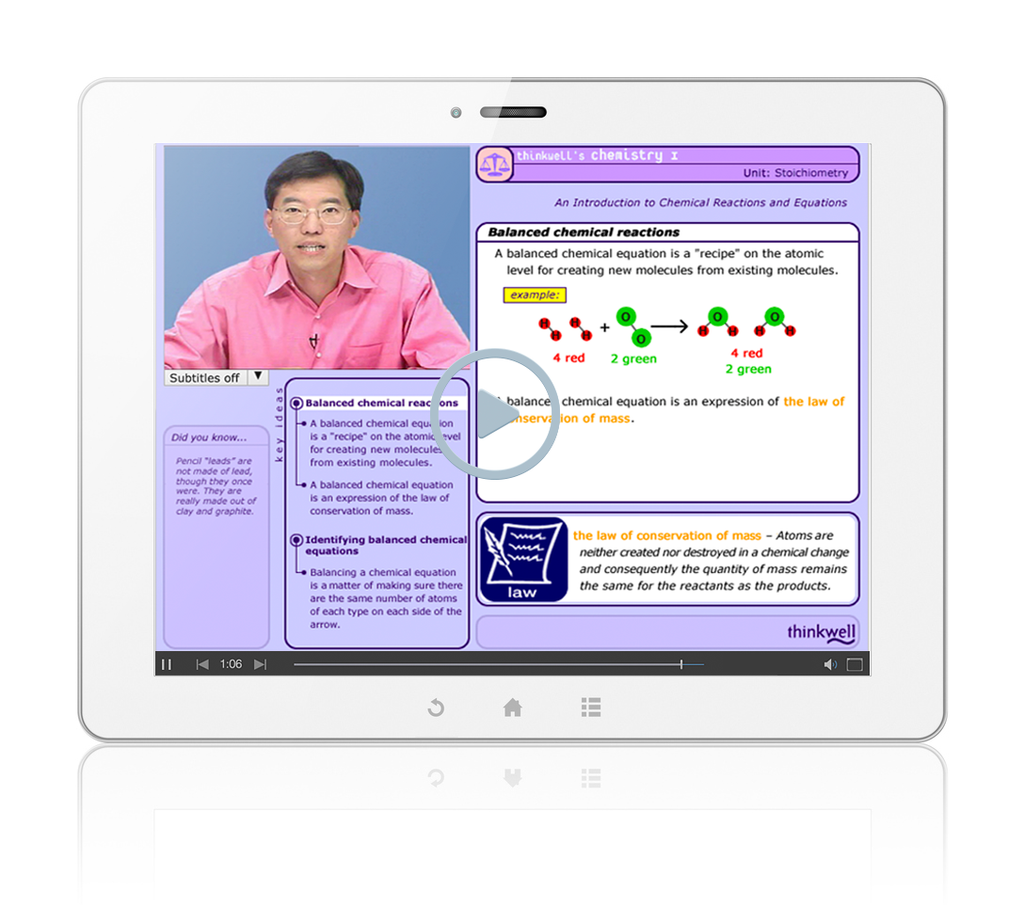
- Thinkwell's video lectures cover the comprehensive scope and sequence of topics covered in a college-level introductory course.
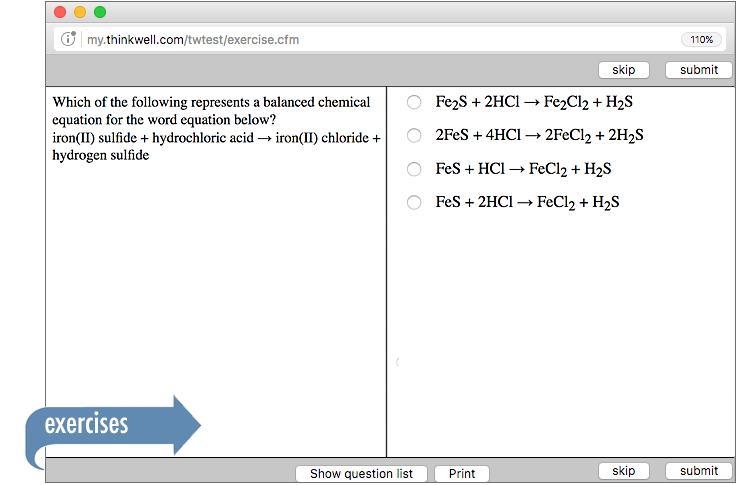
- Our automatically graded exercises with immediate feedback allow you to quickly determine which areas you'll need to spend extra time studying.
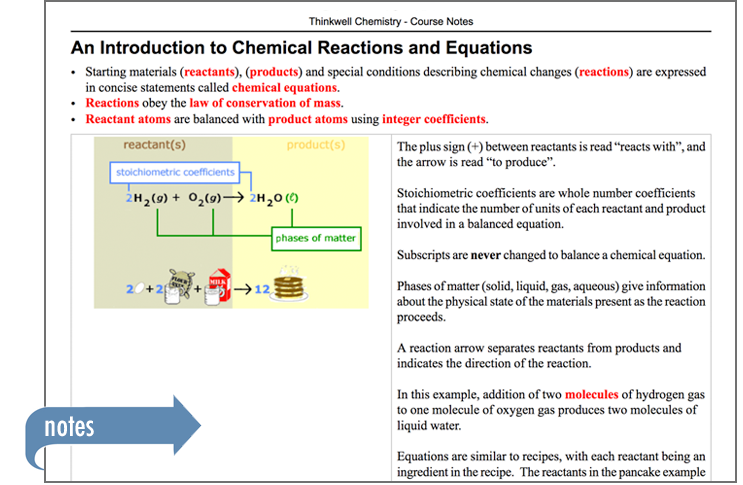
- Concise, illustrated review notes help you distill the fundamental ideas, concepts, and formulas you'll need to know.
- Subscriptions start when you are ready. Buy now and activate your course anytime you like. Wait up to one year to activate your subscription; your 12-month subscription doesn't begin until you say so!
Chemistry Details
Thinkwell's Chemistry includes all of these features to prepare you for the big exam:
- More than 260 video lessons
- 1000+ interactive chemistry problems with immediate feedback allow you to track your progress
- Practice tests and final tests for all 14 chapters, as well as a midterm and a final (only available in the homeschool version)
- Interactive animations with audio
- Printable illustrated notes for each topic
- Glossary of more than 850 chemistry terms
- Engaging content to help students advance their knowledge of chemistry:
- Atoms, molecules, and ions
- Stoichiometry and the mole
- Reactions in aqueous solutions
- Gases, liquids, and solids
- Modern atomic theory and quantum mechanics
- Electron configurations and periodicity
- Chemical bonding and reactions
- Properties of solutions
- Acids and bases
- Thermochemistry, electrochemistry, and biochemistry
Table of Contents
1. An Introduction to Matter and Measurement
- 1.1 An Introduction to Chemistry and the Scientific Method
- 1.1.1 An Introduction to Chemistry
- 1.1.2 The Scientific Method
- 1.2 Properties of Matter
- 1.2.1 States of Matter
- 1.2.2 A Word About Laboratory Safety
- 1.2.3 CIA Demonstration: Differences in Density Due to Temperature
- 1.2.4 Properties of Matter
- 1.3 Scientific Measurement
- 1.3.1 The Measurement of Matter
- 1.3.2 Precision and Accuracy
- 1.3.3 CIA Demonstration: Precision and Accuracy with Glassware
- 1.3.4 Significant Figures
- 1.3.5 Dimensional Analysis
- 1.4 Mathematics of Chemistry
- 1.4.1 Scientific (Exponential) Notation
- 1.4.2 Common Mathematical Functions
2. Atoms, Molecules, and Ions
- 2.1 Early Atomic Theory
- 2.1.1 Early Discoveries and the Atom
- 2.1.2 Understanding Electrons
- 2.1.3 Understanding the Nucleus
- 2.2 Atomic Structure
- 2.2.1 Mass Spectrometry: Determining Atomic Masses
- 2.2.2 Examining Atomic Structure
- 2.2.3 CIA Demonstration: Flame Colors
- 2.3 The Periodic Table
- 2.3.1 Creating the Periodic Table
- 2.4 Chemical Nomenclature
- 2.4.1 Describing Chemical Formulas
- 2.4.2 Naming Chemical Compounds
- 2.4.3 Organic Nomenclature
3. Stoichiometry
- 3.1 Chemical Equations
- 3.1.1 An Introduction to Chemical Reactions and Equations
- 3.1.2 CIA Demonstration: Magnesium and Dry Ice
- 3.1.3 Balancing Chemical Equations
- 3.2 The Mole
- 3.2.1 The Mole and Avogadro's Number
- 3.2.2 Introducing Conversions of Masses, Moles, and Number of Particles
- 3.3 Solving Problems Involving Mass/Mole Relationships
- 3.3.1 Finding Empirical and Molecular Formulas
- 3.3.2 Stoichiometry and Chemical Equations
- 3.3.3 Finding Limiting Reagents
- 3.3.4 CIA Demonstration: Self-Inflating Hydrogen Balloons
- 3.3.5 Theoretical Yield and Percent Yield
- 3.3.6 A Problem Using the Combined Concepts of Stoichiometry
4. Reactions in Aqueous Solutions
- 4.1 An Introduction to Solutions
- 4.1.1 Properties of Solutions
- 4.1.2 CIA Demonstration: The Electric Pickle
- 4.1.3 Concentrations of Solutions
- 4.1.4 Factors Determining Solubility
- 4.2 Reactions Involving Solutions
- 4.2.1 Precipitation Reactions
- 4.2.2 Acid-Base Reactions
- 4.2.3 Oxidation-Reduction Reactions
- 4.3 Stoichiometry Problems in Solutions
- 4.3.1 Acid-Base Titrations
- 4.3.2 Solving Titration Problems
- 4.3.3 Gravimetric Analysis
5. Gases
- 5.1 Gases and Gas Laws
- 5.1.1 Properties of Gases
- 5.1.2 Boyle's Law
- 5.1.3 Charles's Law
- 5.1.4 The Combined Gas Law
- 5.1.5 Avogadro's Law
- 5.1.6 CIA Demonstration: The Potato Cannon
- 5.2 The Ideal Gas Law and Kinetic-Molecular Theory of Gases
- 5.2.1 The Ideal Gas Law
- 5.2.2 Partial Pressure and Dalton's Law
- 5.2.3 Applications of the Gas Laws
- 5.2.4 The Kinetic-Molecular Theory of Gases
- 5.2.5 CIA Demonstration: The Ammonia Fountain
- 5.3 Molecular Motion of Gases
- 5.3.1 Molecular Speeds
- 5.3.2 Effusion and Diffusion
- 5.4 Behavior of Real Gases
- 5.4.1 Comparing Real and Ideal Gases
6. Thermochemistry
- 6.1 An Introduction to Energy
- 6.1.1 The Nature of Energy
- 6.1.2 Energy, Calories, and Nutrition
- 6.1.3 The First Law of Thermodynamics
- 6.1.4 Work
- 6.1.5 Heat
- 6.1.6 CIA Demonstration: Cool Fire
- 6.2 Enthalpy
- 6.2.1 Heats of Reaction: Enthalpy
- 6.2.2 CIA Demonstration: The Thermite Reaction
- 6.3 Calorimetry
- 6.3.1 Constant Pressure Calorimetry
- 6.3.2 Bomb Calorimetry (Constant Volume)
- 6.4 Hess's Law and Enthalpies of Formation
- 6.4.1 Hess's Law
- 6.4.2 Enthalpies of Formation
7. Modern Atomic Theory
- 7.1 Electromagnetic Radiation and the Idea of Quantum
- 7.1.1 The Wave Nature of Light
- 7.1.2 Absorption and Emission
- 7.1.3 CIA Demonstration: Luminol
- 7.1.4 The Ultraviolet Catastrophe
- 7.1.5 The Photoelectric Effect
- 7.1.6 The Bohr Model
- 7.1.7 The Heisenberg Uncertainty Principle
- 7.2 Quantum Mechanics
- 7.2.1 The Wave Nature of Matter
- 7.2.2 Radial Solutions to the Schrödinger Equation
- 7.2.3 Angular Solutions to the Schrödinger Equation
- 7.3 Atomic Orbitals
- 7.3.1 Atomic Orbital Size
- 7.3.2 Atomic Orbital Shapes and Quantum Numbers
- 7.3.3 Atomic Orbital Energy
8. Electron Configurations and Periodicity
- 8.1 Electron Spin and the Pauli Exclusion Principle
- 8.1.1 Understanding Electron Spin
- 8.1.2 Electron Shielding
- 8.1.3 Electron Configurations Through Neon
- 8.1.4 Electron Configurations Beyond Neon
- 8.1.5 Periodic Relationships
- 8.2 Periodicity
- 8.2.1 Periods and Atomic Size
- 8.2.2 Ionization Energy
- 8.2.3 Electron Affinity
- 8.2.4 An Introduction to Electronegativity
- 8.3 Group Trends
- 8.3.1 Hydrogen, Alkali Metals, and Alkaline Earth Metals
- 8.3.2 Transition Metals and Nonmetals
9. Chemical Bonding: Fundamental Concepts
- 9.1 Valence Electrons and Chemical Bonding
- 9.1.1 Valence Electrons and Chemical Bonding
- 9.1.2 Ionic Bonds
- 9.1.3 CIA Demonstration: Conductivity Apparatus-Ionic versus Covalent Bonds
- 9.2 Lewis Dot Structures
- 9.2.1 Lewis Dot Structures for Covalent Bonds
- 9.2.2 Predicting Lewis Dot Structures
- 9.3 Resonance Structures and Formal Charge
- 9.3.1 Resonance Structures
- 9.3.2 Formal Charge
- 9.3.3 Electronegativity, Formal Charge, and Resonance
- 9.4 Bond Properties
- 9.4.1 Bond Properties
- 9.4.2 Using Bond Dissociation Energies
10. Molecular Geometry and Bonding Theory
- 10.1 Molecular Geometry and the VSEPR Theory
- 10.1.1 Valence-Shell Electron-Pair Repulsion Theory
- 10.1.2 Molecular Shapes for Steric Numbers 2-4
- 10.1.3 Molecular Shapes for Steric Numbers 5 & 6
- 10.1.4 Predicting Molecular Characteristics Using VSEPR Theory
- 10.2 Valence Bond Theory and Molecular Orbital Theory
- 10.2.1 Valence Bond Theory
- 10.2.2 An Introduction to Hybrid Orbitals
- 10.2.3 Pi Bonds
- 10.2.4 Molecular Orbital Theory
- 10.2.5 Applications of the Molecular Orbital Theory
- 10.2.6 Beyond Homonuclear Diatomics
- 10.2.7 CIA Demonstration: The Paramagnetism of Oxygen
11. Oxidation-Reduction Reactions
- 11.1 Looking In-Depth at Redox Reactions
- 11.1.1 Oxidation Numbers
- 11.1.2 Balancing Redox Reactions by the Oxidation Number Method
- 11.1.3 Balancing Redox Reactions Using the Half-Reaction Method
- 11.1.4 The Activity Series of the Elements
- 11.1.5 CIA Demonstration: The Reaction Between Al and Br2
12. Condensed Phases: Liquids and Solids
- 12.1 Intermolecular Forces
- 12.1.1 An Introduction to Intermolecular Forces and States of Matter
- 12.1.2 Intermolecular Forces
- 12.2 Physical Properties of Liquids
- 12.2.1 Properties of Liquids
- 12.2.2 CIA Demonstration: Boiling Water at Reduced Pressure
- 12.2.3 Vapor Pressure and Boiling Point
- 12.2.4 Molecular Structure and Boiling Point
- 12.2.5 Phase Diagrams
- 12.2.6 CIA Demonstration: Boiling Water in a Paper Cup
- 12.3 Solid State: Structure and Bonding
- 12.3.1 Types of Solids
- 12.3.2 CIA Demonstration: The Conductivity of Molten Salts
- 12.3.3 Crystal Structure
- 12.3.4 Calculating Atomic Mass and Radius from a Unit Cell
- 12.3.5 Crystal Packing
- 12.4 Ceramics
- 12.4.1 Ceramics and Glass
- 12.4.2 CIA Demonstration: Superconductivity
13. Physical Properties of Solutions
- 13.1 Characterizing Solutions
- 13.1.1 Types of Solutions
- 13.1.2 Molarity and the Mole Fraction
- 13.1.3 Molality
- 13.1.4 Energy and the Solution Process
- 13.2 Effects of Temperature and Pressure on Solubility
- 13.2.1 Temperature Change and Solubility
- 13.2.2 Extractions
- 13.2.3 Pressure Change and Solubility
- 13.3 Colligative Properties
- 13.3.1 Vapor Pressure Lowering
- 13.3.2 Boiling Point Elevation and Freezing Point Depression
- 13.3.3 Boiling Point Elevation Problem
- 13.3.4 Osmosis
- 13.3.5 Colligative Properties of Ionic Solutions
- 13.4 Colloids
- 13.4.1 Colloid Formation and Flocculation
- 13.4.2 CIA Demonstration: The Tyndall Effect
14. Chemical Kinetics
- 14.1 Reaction Rates
- 14.1.1 An Introduction to Reaction Rates
- 14.1.2 Rate Laws: How the Reaction Rate Depends on Concentration
- 14.1.3 Determining the Form of a Rate Law
- 14.2 Orders of Reaction
- 14.2.1 First-Order Reactions
- 14.2.2 Second-Order Reactions
- 14.2.3 A Kinetics Problem
- 14.3 Temperature and Rates
- 14.3.1 The Collision Model
- 14.3.2 The Arrhenius Equation
- 14.3.3 Using the Arrhenius Equation
- 14.4 Reaction Mechanisms
- 14.4.1 Defining the Molecularity of a Reaction
- 14.4.2 Determining the Rate Laws of Elementary Reactions
- 14.4.3 Calculating the Rate Laws of Multi-step Reactions
- 14.4.4 Steady State Kinetics
- 14.5 Catalysts
- 14.5.1 Catalysts and Types of Catalysts
- 14.5.2 A Word About Laboratory Safety
- 14.5.3 CIA Demonstration: Elephant Snot
- 14.5.4 CIA Demonstration: The Cobalt(II)-Catalyzed Reaction of Potassium Sodium Tartrate
- 14.5.5 CIA Demonstration: The Copper-Catalyzed Decomposition of Acetone
15. Chemical Equilibrium
- 15.1 Principles of Chemical Equilibrium
- 15.1.1 The Concept of Equilibrium
- 15.1.2 The Law of Mass Action and Types of Equilibrium
- 15.1.3 Converting Between Kc and Kp
- 15.2 Using Equilibrium Constants
- 15.2.1 Approaching Chemical Equilibrium
- 15.2.2 Predicting the Direction of a Reaction
- 15.2.3 Strategies for Solving Equilibrium Problems
- 15.2.4 Solving Problems Far from Equilibrium
- 15.2.5 An Equilibrium Problem Using the Quadratic Equation
- 15.3 Shifting Chemical Equilibrium
- 15.3.1 Le Châtelier's Principle
- 15.3.2 The Effect of Changing Amounts on Equilibrium
- 15.3.3 The Effects of Pressure and Volume on Equilibrium
- 15.3.4 The Effects of Temperature and Catalysts on Equilibrium
- 15.3.5 CIA Demonstration: NO2/N2O4
- 15.3.6 CIA Demonstration: Shifting the Equilibrium of FeSCN2+
16. Acids and Bases
- 16.1 Acid-Base Concepts
- 16.1.1 Arrhenius/Brønsted-Lowry Definitions of Acids and Bases
- 16.1.2 Hydronium, Hydroxide, and the pH Scale
- 16.2 Acid and Base Strengths
- 16.2.1 Strong Acids and Bases
- 16.2.2 CIA Demonstration: Natural Acid-Base Indicators
- 16.2.3 Weak Acids
- 16.2.4 Weak Bases
- 16.2.5 Lewis Acids and Bases
- 16.2.6 Trends in Acid and Base Strengths
- 16.3 Polyprotic Acids
- 16.3.1 Examining Polyprotic Acids
- 16.4 Acid-Base Properties of Salts
- 16.4.1 Acid-Base Properties of Salt Solutions
17. Equilibrium in Aqueous Solution
- 17.1 Reactions of Acids and Bases
- 17.1.1 Strong Acid-Strong Base and Weak Acid-Strong Base Reactions
- 17.1.2 Strong Acid-Weak Base and Weak Acid-Weak Base Reactions
- 17.1.3 The Common Ion Effect
- 17.2 Buffers
- 17.2.1 An Introduction to Buffers
- 17.2.2 CIA Demonstration: Buffers in Action
- 17.2.3 Acidic Buffers
- 17.2.4 Basic Buffers
- 17.2.5 The Henderson-Hasselbalch Equation
- 17.3 Acid-Base Titration
- 17.3.1 Strong Acid-Strong Base Titration
- 17.3.2 CIA Demonstration: Barium Hydroxide-Sulfuric Acid Titration
- 17.3.3 Weak Acid-Strong Base Titration
- 17.3.4 Polyprotic Acid-Strong Base Titration
- 17.3.5 Weak Base-Strong Acid Titration
- 17.3.6 Acid-Base Indicators
- 17.4 Solubility Equilibria
- 17.4.1 The Solubility Product Constant
- 17.4.2 CIA Demonstration: Silver Chloride and Ammonia
- 17.4.3 Solubility and the Common Ion Effect
- 17.4.4 Fractional Precipitation
- 17.4.5 The Effects of pH on Solubility
- 17.5 Complex Ion Equilibria
- 17.5.1 The Formation of Complex Ions
- 17.5.2 Amphoteric Metal Hydroxides
18. Introduction to Organic Reactions
- 18.1 Acid Strength in Organic Molecules
- 18.1.1 An Introduction to Reactivity
- 18.1.2 Bond Strengths
- 18.1.3 Inductive Effects
- 18.1.4 Hybridization Effects
- 18.1.5 Resonance Effects
- 18.1.6 Solvent Effects: Acid Dissociation versus Proton Affinity
- 18.2 Base Strength in Organic Molecules
- 18.2.1 A Review of Relationship Between Acids and Conjugate Bases
- 18.2.2 Strengths of Organic Bases
- 18.2.3 Solvent Effects on Organic Base Strength
- 18.3 Lewis Acid and Base Reactions
- 18.3.1 Lewis Acids and the Formation of Acid-Base Adducts
- 18.3.2 Oxides as Lewis Acids
- 18.4 Introduction to Electrophiles and Nucleophiles
- 18.4.1 Nucleophilic Substitution at sp3 Carbon
- 18.4.2 Nucleophilic Substitution at sp2 Carbon
- 18.4.3 Elimination Reactions
- 18.4.4 CIA Demonstration: Slime
19. Thermodynamics
- 19.1 An Introduction to Thermodynamics
- 19.1.1 Spontaneous Processes
- 19.2 Entropy
- 19.2.1 Entropy and the Second Law of Thermodynamics
- 19.2.2 Entropy and Temperature
- 19.3 Gibbs Free Energy and Free Energy Change
- 19.3.1 Gibbs Free Energy
- 19.3.2 Standard Free Energy Changes of Formation
- 19.4 Using Free Energy
- 19.4.1 Enthalpy and Entropy Contributions to K
- 19.4.2 The Temperature Dependence of K
- 19.4.3 Free Energy Away from Equilibrium
20. Electrochemistry
- 20.1 Principles of Electrochemistry
- 20.1.1 Reviewing Oxidation-Reduction Reactions
- 20.2 Galvanic Cells
- 20.2.1 Electrochemical Cells
- 20.2.2 Electromotive Force
- 20.2.3 Standard Reduction Potentials
- 20.2.4 Using Standard Reduction Potentials
- 20.2.5 The Nernst Equation
- 20.2.6 Electrochemical Determinants of Equilibria
- 20.3 Batteries
- 20.3.1 Batteries
- 20.3.2 CIA Demonstration: The Fruit-Powered Clock
- 20.4 Corrosion
- 20.4.1 Corrosion and the Prevention of Corrosion
- 20.5 Electrolysis and Electrolytic Cells
- 20.5.1 Electrolytic Cells
- 20.5.2 The Stoichiometry of Electrolysis
21. Nuclear Chemistry
- 21.1 Radioactivity
- 21.1.1 The Nature of Radioactivity
- 21.1.2 The Stability of Atomic Nuclei
- 21.1.3 Binding Energy
- 21.2 Rates of Disintegration
- 21.2.1 Rates of Disintegration Reactions
- 21.2.2 Radiochemical Dating
- 21.3 Nuclear Fission and Fusion
- 21.3.1 Nuclear Fission
- 21.3.2 Nuclear Fusion
- 21.3.3 Applications of Nuclear Chemistry
22. Chemistry of Metals
- 22.1 An Introduction to Metals
- 22.1.1 Metallurgical Processes
- 22.1.2 The Band Theory of Conductivity
- 22.1.3 Intrinsic Semiconductors
- 22.1.4 Doped Semiconductors
- 22.2 Physical and Chemical Processes of Metals
- 22.2.1 The Alkali Metals
- 22.2.2 The Alkaline Earth Metals
- 22.2.3 Aluminum
- 22.2.4 CIA Demonstration: The Reaction Between Al and Br2
23. Transition Metals
- 23.1 Examining Transition Metals
- 23.1.1 Properties of Transition Metals
- 23.1.2 CIA Demonstration: Copper One-Pot Reactions
- 23.2 Coordination Compounds
- 23.2.1 Complexes and Ligands
- 23.2.2 Naming Coordination Compounds
- 23.2.3 Structures of Coordination Compounds and Isomers
- 23.3 Bonding in Coordination Compounds
- 23.3.1 Color and Transition Metals
- 23.3.2 Crystal Field Theory
- 23.3.3 Ligand Field Theory
- 23.3.4 Magnetic Properties and Spin
24. Nonmetals
- 24.1 An Introduction to Nonmetals and Hydrogen
- 24.1.1 General Properties of Nonmetals
- 24.1.2 Hydrogen
- 24.2 Group 14: Carbon and Silicon
- 24.2.1 General Properties of Carbon
- 24.2.2 Silicon
- 24.3 Group 15: Nitrogen and Phosphorus
- 24.3.1 Nitrogen
- 24.3.2 Phosphorus
- 24.4 Group 16: Oxygen and Sulfur
- 24.4.1 Oxygen
- 24.4.2 CIA Demonstration: Creating Acid Rain
- 24.4.3 Sulfur
- 24.5 Group 17: The Halogens
- 24.5.1 Halogens
- 24.5.2 Aqueous Halogen Compounds
- 24.6 Group 18: The Noble Gases
- 24.6.1 Properties of Noble Gases
25. Organic Chemistry
- 25.1 Hydrocarbons
- 25.1.1 Alkanes
- 25.1.2 Alkenes and Alkynes
- 25.1.3 Isomers
- 25.1.4 Aromatic Hydrocarbons
- 25.2 The Functional Groups
- 25.2.1 Alcohols, Ethers, and Amines
- 25.2.2 Carbonyl-Containing Functional Groups
- 25.3 Organic Polymers
- 25.3.1 Organic Polymers
- 25.3.2 CIA Demonstration: The Synthesis of Nylon
26. Biochemistry
- 26.1 Biological Molecules
- 26.1.1 Proteins
- 26.1.2 Nucleic Acids
- 26.1.3 Carbohydrates
- 26.1.4 Lipids
27. Instructional Laboratory Demonstrations
- 27.1 Laboratory Techniques
- 27.1.1 CIA Demonstration: Laboratory Safety
- 27.1.2 CIA Demonstration: Chromatography
- 27.1.3 CIA Demonstration: Distillation
- 27.1.4 CIA Demonstration: Pipetting
- 27.1.5 CIA Demonstration: Dilutions
- 27.1.6 CIA Demonstration: Titrations
- 27.1.7 CIA Demonstration: Extractions
- 27.1.8 CIA Demonstration: Filtrations
- 27.1.9 CIA Demonstration: Weighing on an Analytical Balance
- 27.1.10 CIA Demonstration: Recrystallization
About the Author
Dean Harman
University of Virginia

Dean Harman is a professor of chemistry at the University of Virginia, where he has been honored with several teaching awards. He heads the Harman Research Group, which specializes in the novel organic transformations made possible by electron-rich metal centers such as Os(II), RE(I), and W(0). Prof. Harman holds a Ph.D. from Stanford University.
Gordon Yee
Virginia Tech

Gordon Yee is an associate professor of chemistry at Virginia Tech in Blacksburg, VA. He received his Ph.D. from Stanford University and completed postdoctoral work at DuPont. A widely published author, Professor Yee studies molecule-based magnetism.
Tarek Sammakia
University of Colorado at Boulder

Tarek Sammakia is a Professor of Chemistry at the University of Colorado at Boulder where he teaches organic chemistry to undergraduate and graduate students. He received his Ph.D. from Yale University and carried out postdoctoral research at Harvard University. He has received several national awards for his work in synthetic and mechanistic organic chemistry.