Pre-Algebra
$169.00
This product is currently sold out.




Pre-Algebra
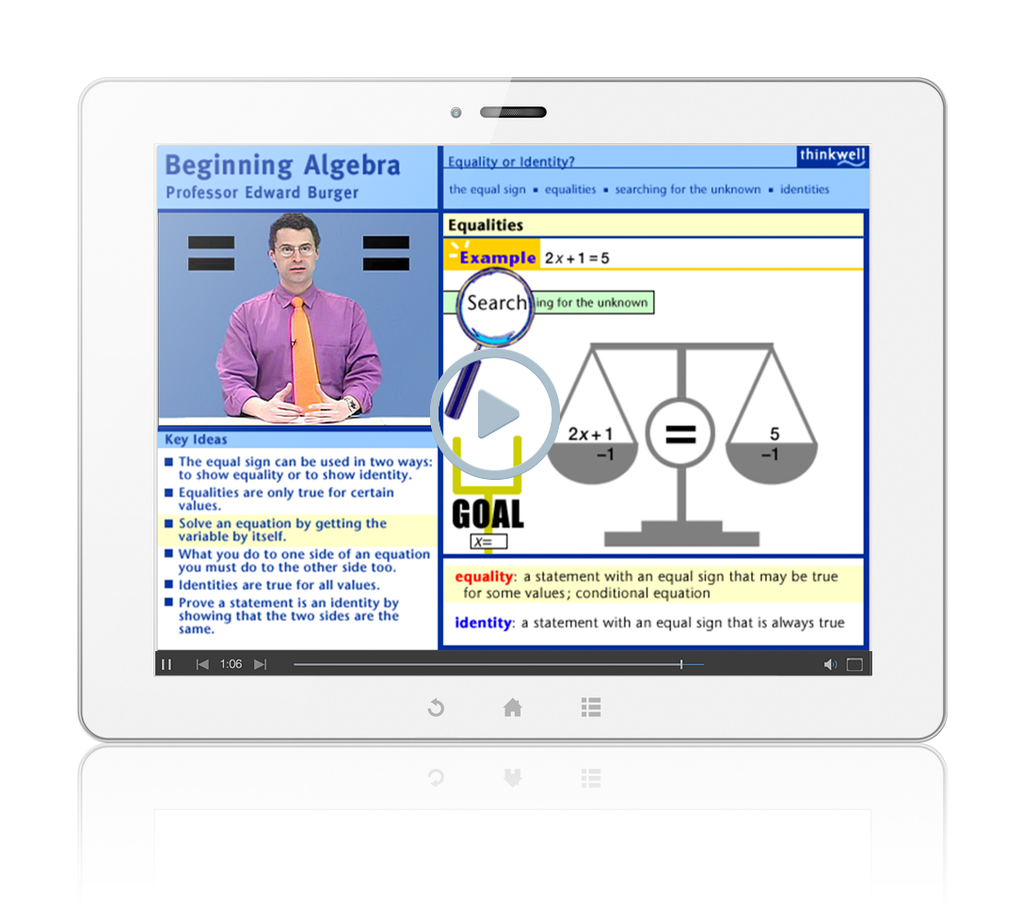
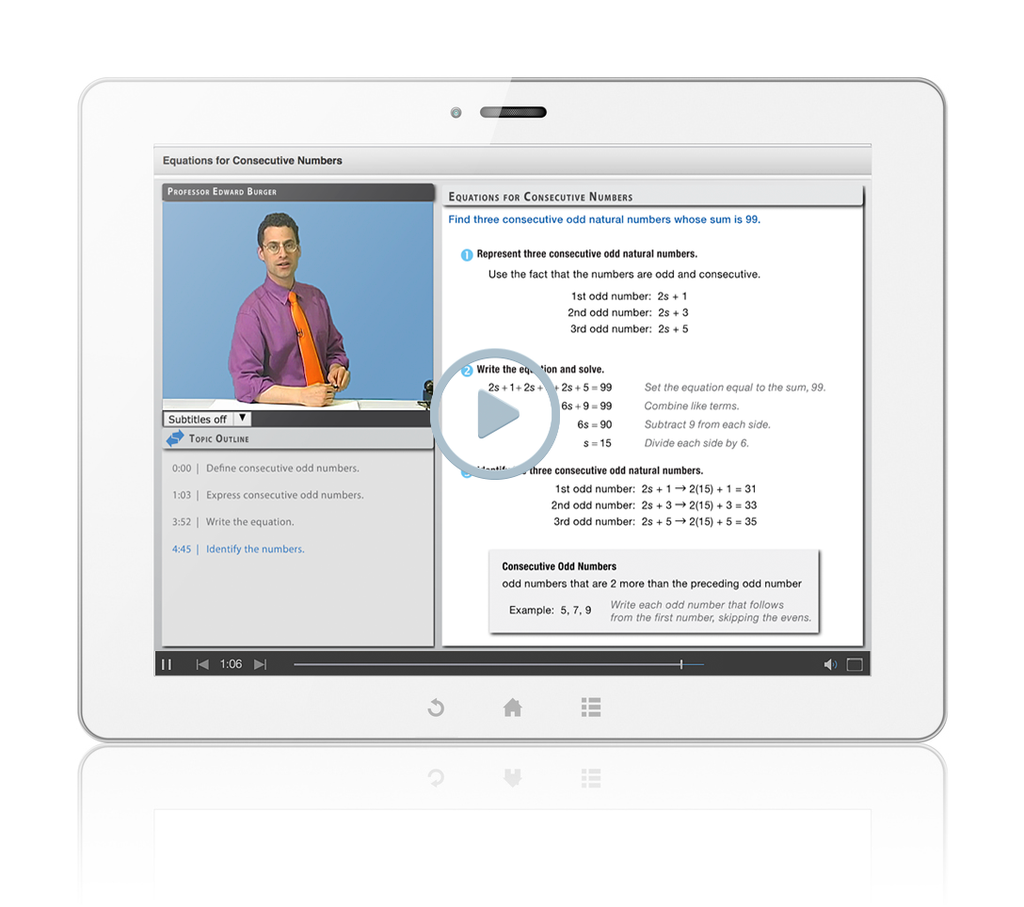
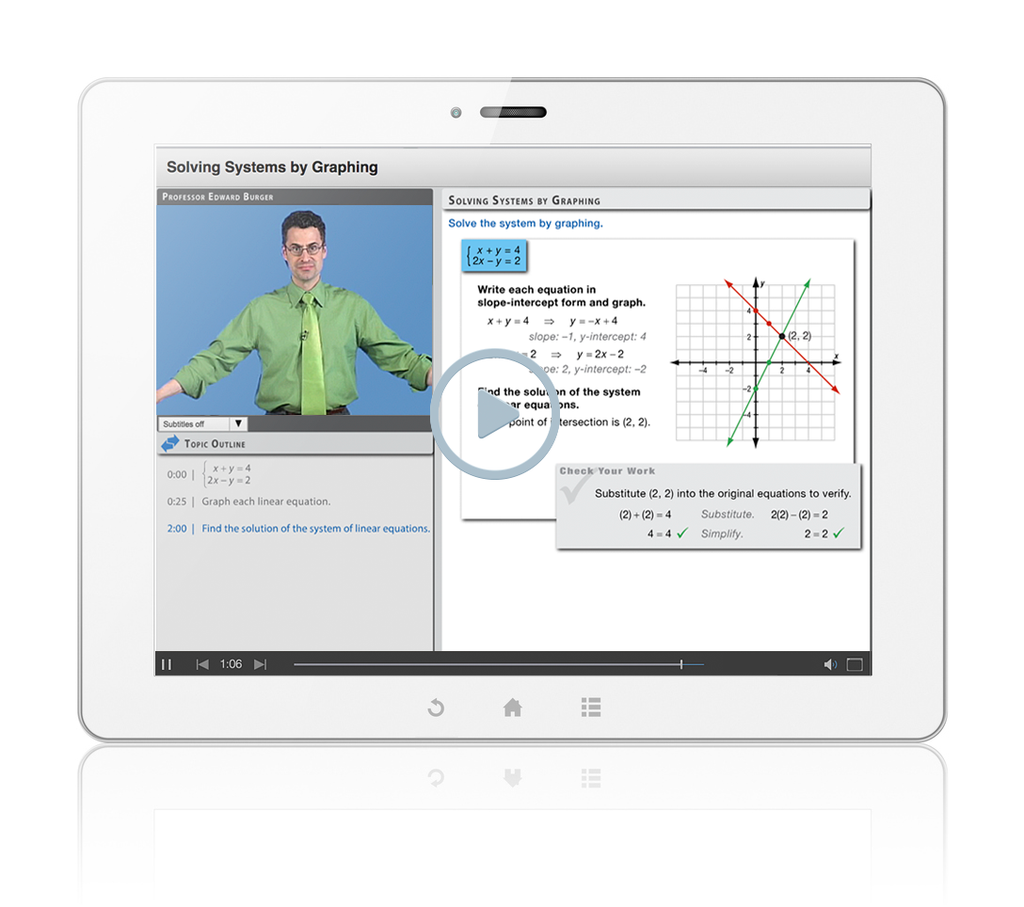
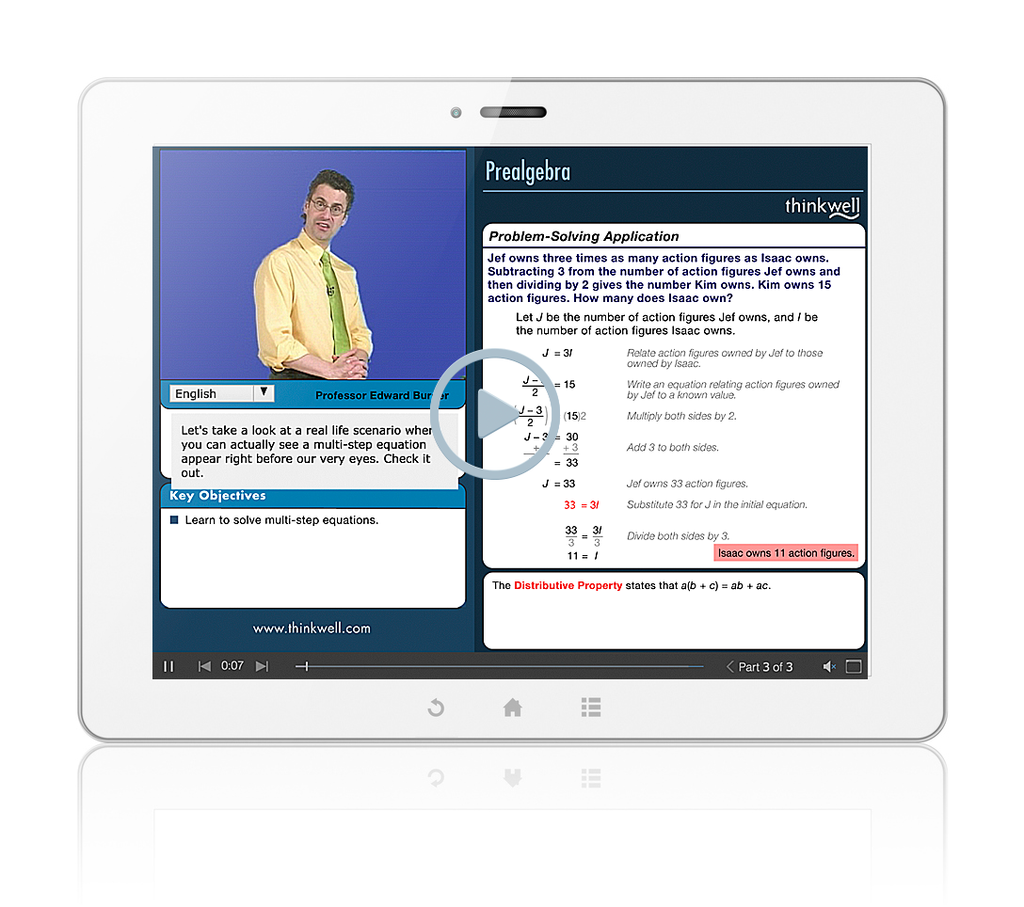
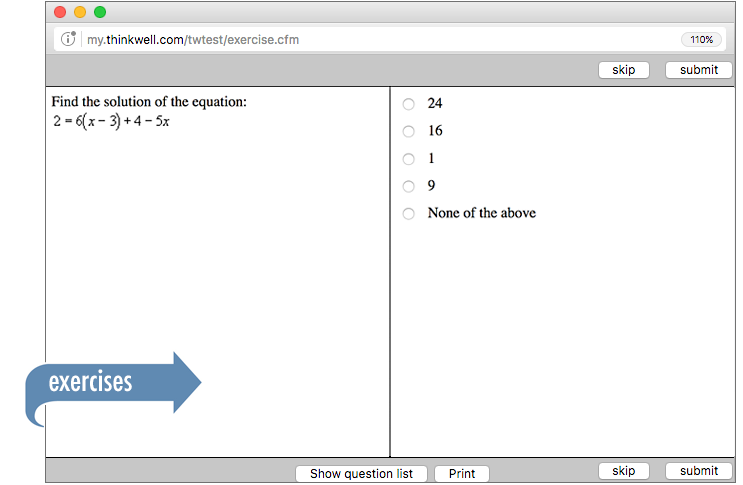
Thinkwell's Pre-Algebra is designed for college and high school students who are preparing for algebra. This course features online videos by award-winning Professor and mathematician Edward Burger who uses example-based tutorials that break Pre-Algebra into the basics, giving students the tips and tricks they need to excel at algebra. Students practice their newly acquired skills with automatically graded online exercises and get step-by-step explanations and answer solutions.
Thinkwell's Pre-Algebra covers the same topics that are in every pre-algebra textbook, so it's easy to use as a study aid. Because it's available any time, day or night, and you only pay one flat fee for 12 months of access, not by the hour, it's better than a pre-algebra tutor.
Our complete Pre-Algebra package includes:- 12-month Online Subscription to our complete Pre-Algebra course with video lessons, automatically graded exercises, and much more.
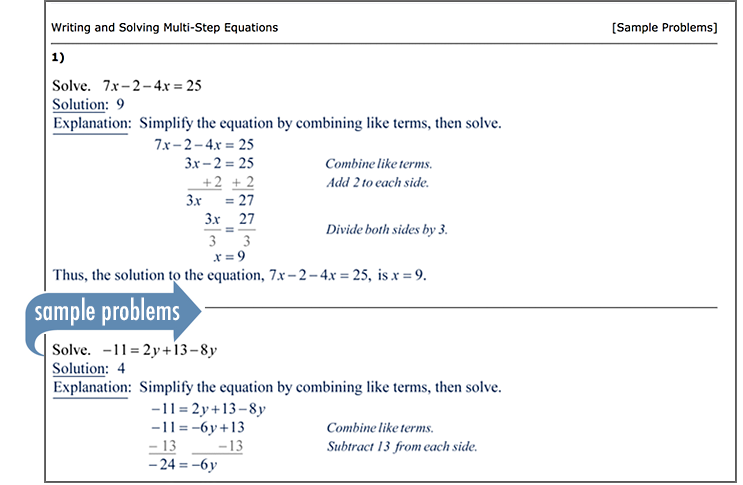
- Workbook (optional) with lecture notes, sample problems, and exercises so that you can study even when away from the computer.
Pre-Algebra Materials
Online Subscription, 12-month access
Access to a complete online package that includes everything you need:
- High-quality video lessons explain all of the Pre-Algebra Math concepts
- Automatically graded exercises with immediate feedback allow you to track your progress
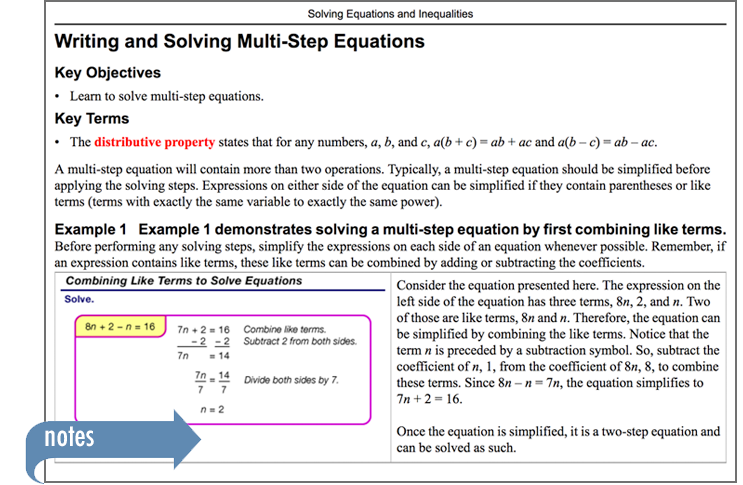
- Printable full-color illustrated notes help you review what you've learned in the video lesson
- Subscriptions start when you are ready. Buy now and activate your course anytime you like. Wait up to one year to activate your subscription; your 12-month subscription doesn't begin until you say so!
Workbook, Notes, sample problems, exercises, and practice problems
Study without a computer. Our workbook companion contains the same lecture notes and sample problems that are delivered online, as well as some additional exercises, all in a convenient print format. Answers to the odd-numbered exercises are in the back of the book. Online Subscription is required; workbook not sold separately.
Pre-Algebra Details
Thinkwell's Pre-Algebra math includes all of these features for your student:
- More than 100 video tutorials
- 1000+ automatically graded Pre-Algebra problems
- Pre-Algebra tests, including 11 chapter tests, as well as practice tests, a midterm, and a final exam (only available in the homeschool version)
- Real-world application examples in both lectures and exercises
- Printable illustrated notes for each topic
- Searchable glossary of mathematical terms
- Engaging content to help students advance their mathematical knowledge:
- Operations with whole numbers, integers, decimals, and fractions
- Variables and expressions
- One-step, two-step, and multi-step equations and inequalities
- Ratios, proportions, and percents
- Simple and compound interest
- Customary and metric units of measurement
- Organizing, displaying, and interpreting data
- Graphing equations and slopes
- Polygons and solids
- The Pythagorean theorem
- Exponents
- Polynomials
- Probability
Table of Contents
1. Whole Numbers
- 1.1 Introduction to Whole Numbers
- 1.1.1 Reading and Writing Whole Numbers
- 1.1.2 Rounding Whole Numbers
- 1.2 Operations with Whole Numbers
- 1.2.1 Adding Whole Numbers
- 1.2.2 Subtracting Whole Numbers
- 1.2.3 Multiplying Whole Numbers
- 1.2.4 Dividing Whole Numbers
- 1.2.5 Properties
2. Integers
- 2.1 Introduction to Integers
- 2.1.1 Integers and the Number Line
- 2.2 Operations with Integers
- 2.2.1 Addition of Integers
- 2.2.2 Subtraction of Integers
- 2.2.3 Multiplication and Division of Integers
- 2.2.4 Introduction to Exponents
- 2.2.5 Using the Order of Operations
3. Fractions
- 3.1 Introduction to Fractions
- 3.1.1 Factors, Multiples, and Equivalent Fractions
- 3.2 Operations with Fractions
- 3.2.1 Multiplying Fractions and Mixed Numbers
- 3.2.2 Dividing Fractions and Mixed Numbers
- 3.2.3 Adding and Subtracting Fractions and Mixed Numbers
4. Decimals
- 4.1 Introduction to Decimals
- 4.1.1 Representing, Comparing, and Ordering Decimals
- 4.1.2 Rounding and Estimating Decimals
- 4.2 Operations with Decimals
- 4.2.1 Adding and Subtracting Decimals
- 4.2.2 Multiplying Decimals
- 4.2.3 Dividing Decimals
- 4.3 Fractions and Decimals
- 4.3.1 Converting between Fractions and Decimals
5. Variables, Expressions, and Equations
- 5.1 Introduction to Equations
- 5.1.1 Variables and Expressions
- 5.1.2 Translating Between Words and Math
- 5.1.3 Simplifying Algebraic Expressions
- 5.1.4 Translating Between Tables and Expressions
- 5.1.5 Equations and Their Solutions
- 5.2 Introduction to Solving Equations
- 5.2.1 Solving Addition Equations
- 5.2.2 Solving Subtraction Equations
- 5.2.3 Solving Multiplication Equations
- 5.2.4 Solving Division Equations
6. Solving Equations and Inequalities
- 6.1 Solving Equations
- 6.1.1 Solving Equations Containing Integers
- 6.1.2 Writing and Solving Two-Step Equations
- 6.1.3 Writing and Solving Multi-Step Equations
- 6.1.4 Solving Equations with Variables on Both Sides
- 6.2 Solving Inequalities
- 6.2.1 Inequalities
- 6.2.2 Solving Inequalities by Adding or Subtracting
- 6.2.3 Solving Inequalities by Multiplying or Dividing
- 6.2.4 Solving Two-Step Inequalities
7. Ratios, Proportions, and Percents
- 7.1 Ratios and Proportions
- 7.1.1 Ratios and Rates
- 7.1.2 Proportions
- 7.1.3 Finding an Unknown Value in a Proportion
- 7.1.4 Applications of Proportions
- 7.2 Percents
- 7.2.1 Introduction to Percents
- 7.2.2 Percents
- 7.2.3 Relating Percents, Decimals, and Fractions
- 7.2.4 Estimating with Percents
- 7.2.5 Finding and Using Percents
- 7.3 Interest
- 7.3.1 Simple Interest
- 7.3.2 Compound Interest
8. Measurement, Statistics, and Graphs
- 8.1 Measurement
- 8.1.1 Understanding Customary Units of Measurement
- 8.1.2 Understanding Metric Units of Measurement
- 8.1.3 Converting Customary Units
- 8.1.4 Converting Metric Units
- 8.1.5 Converting between Customary and Metric Units
- 8.1.6 Time and Temperature
- 8.2 Organizing, Displaying, and Interpreting Data
- 8.2.1 Organizing Data
- 8.2.2 Bar Graphs and Histograms
- 8.2.3 Line Graphs
- 8.2.4 Reading and Interpreting Circle Graphs
- 8.2.5 Measures of Central Tendency
- 8.2.6 Box-and-Whisker Plots
- 8.3 Graphing Equations and Slope
- 8.3.1 The Coordinate Plane
- 8.3.2 Tables and Graphs
- 8.3.3 Graphing Linear Equations
- 8.3.4 Graphing Using Intercepts
- 8.3.5 An Introduction to Slope
- 8.3.6 Finding the Slope Given Two Points
9. Geometry
- 9.1 Polygons
- 9.1.1 Triangles
- 9.1.2 Quadrilaterals
- 9.1.3 Finding Angles in Polygons
- 9.2 Polygon Relationships
- 9.2.1 Similar Figures
- 9.2.2 Congruent Figures
- 9.3 Area, Perimeter, and Circumference
- 9.3.1 Perimeter
- 9.3.2 Area of Rectangles and Parallelograms
- 9.3.3 Area of Triangles and Trapezoids
- 9.3.4 Circles and Circumference
- 9.3.5 Area of Circles
- 9.3.6 Area of Composite Figures
- 9.3.7 Comparing Perimeter and Area
- 9.4 The Pythagorean Theorem
- 9.4.1 Square Roots and the Pythagorean Theorem
- 9.5 Solids
- 9.5.1 Introduction to Three-Dimensional Figures
- 9.5.2 Volume of Prisms and Cylinders
- 9.5.3 Volume of Pyramids and Cones
- 9.5.4 Surface Area of Prisms and Cylinders
- 9.5.5 Surface Area of Pyramids and Cones
- 9.5.6 Volume and Surface Area of Spheres
10. Exponents and Polynomials
- 10.1 Exponents
- 10.1.1 Product and Power Properties of Exponents
- 10.1.2 Integer Exponents
- 10.1.3 Quotient Properties of Exponents
- 10.1.4 An Application of Exponents: Scientific Notation
- 10.2 Introduction to Polynomials
- 10.2.1 Introduction to Polynomials
- 10.2.2 Simplifying Polynomials
- 10.3 Operations with Polynomials
- 10.3.1 Adding and Subtracting Polynomials
- 10.3.2 Multiplying and Dividing Monomials
- 10.3.3 Multiplying Monomials by Polynomials
- 10.3.4 Multiplying Binomials
- 10.4 Factoring Polynomials
- 10.4.1 Factoring with the GCF
- 10.4.2 Factoring by Grouping
- 10.4.3 Factoring Trinomials
11. Probability
- 11.1 Understanding Probability
- 11.1.1 Introduction to Probability
- 11.1.2 Experimental Probability
- 11.1.3 Counting Methods and Sample Spaces
- 11.1.4 Theoretical Probability
- 11.2 Using Probability
- 11.2.1 Compound Events
- 11.2.2 Making Predictions
- 11.2.3 Probability of Independent and Dependent Events
- 11.2.4 Permutations and Combinations
About the Author

Edward Burger is an award-winning professor with a passion for teaching mathematics.
Since 2013, Edward Burger has been President of Southwestern University, a top-ranked liberal arts college in Georgetown, Texas. Previously, he was Professor of Mathematics at Williams College. Dr. Burger earned his Ph.D. at the University of Texas at Austin, having graduated summa cum laude with distinction in mathematics from Connecticut College.
Prof. Burger's unique sense of humor and his teaching expertise combine to make him the ideal presenter of Thinkwell's entertaining and informative video lectures.