Public Speaking
$99.00
This product is currently sold out.




Public Speaking
Do you have a fear of public speaking? Do you need help preparing for class or work presentations? Learn the art of public speaking with Thinkwell's Public Speaking study aid, so that no matter when you need to speak in front of a crowd, whether it's a toast for a friend's wedding, an oral report for class, or a high-stakes presentation for your CEO or a client, you'll know the tips and tricks to help you feel confident and relaxed.
Our complete Public Speaking package includes:- 12-month Online Subscription to our complete Public Speaking course with video lessons, automatically graded problems, and much more.
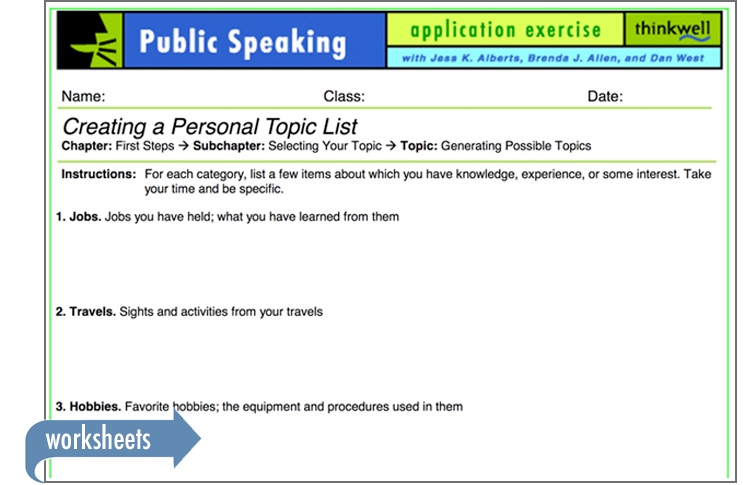
- Companion Workbook (optional) with printed lecture notes, applications, and notable speeches that you can study when away from your computer.
Worktext requires the purchase of an online subscription.
Public Speaking Materials
Online Subscription, 12-month access
Access to a complete online package that includes everything you need.
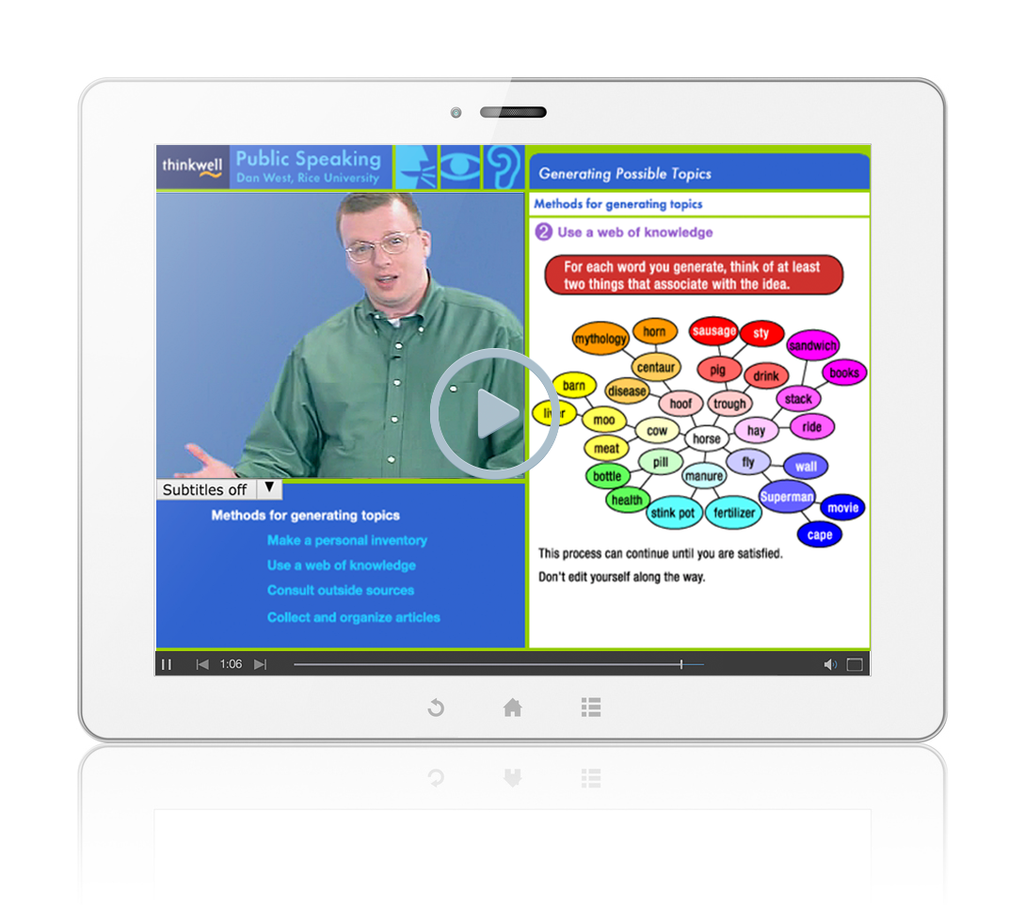
- Thinkwell's video lectures cover the comprehensive scope and sequence of topics related to speaking in public.
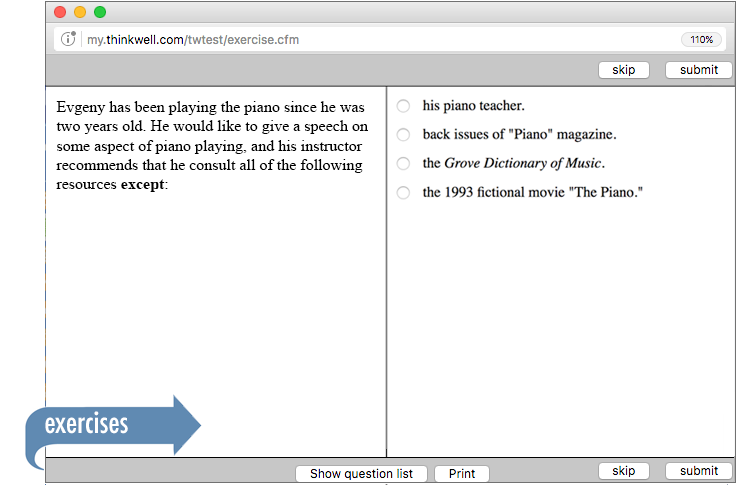
- Our automatically graded exercises with immediate feedback allow you to quickly determine which areas you'll need to spend extra time studying.
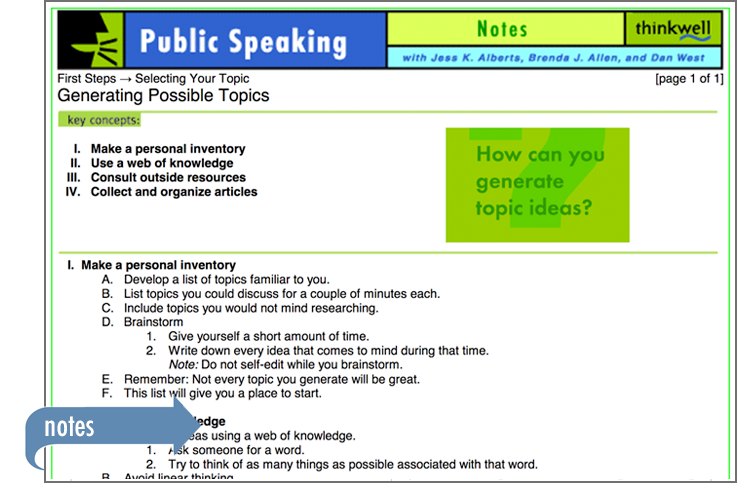
- Concise, illustrated review notes help you distill the fundamental ideas, concepts, and formulas you'll need to know.
- Subscriptions start when you are ready. Buy now and activate your course anytime you like. Wait up to one year to activate your subscription; your 12-month subscription doesn't begin until you say so!
Companion Worktext
Convenient printed version of our notes, applications, and notable speeches that you can study when away from your computer.
Public Speaking Details
Thinkwell's Public Speaking includes:
- Equivalent to 11th- or 12th-grade Public Speaking
- More than 140 video lessons
- 1000+ automatically graded problems with immediate feedback allow you to track your progress
- Printable illustrated notes for each topic
- Closed captioning for all videos
- Searchable glossary of more than 150 public-speaking terms
- Engaging content to help students improve their public speaking skills:
- Benefits, history, and theory of communication
- Ethical speaking practices
- Overcoming speaker anxiety
- Speaking inclusively
- Audience analysis
- Selecting, developing, and researching a topic
- Organizing and outlining a speech
- Effective speech delivery
- Using visual aids
- Principles of informative and persuasive speeches
- Notable speeches from figures such as John F. Kennedy, Martin Luther King, Jr., Barbara Jordan, Geraldine Ferraro, and Ronald Reagan
Table of Contents
1. Introduction to Public Speaking- 1.1 Benefits, History, and Theories of Communication
- 1.1.1 Why Public Speaking is Important to You
- 1.1.2 Student Voices: "Let me tell you..."
- 1.1.3 The Legacy of Public Speaking
- 1.1.4 Categories of Communication
- 1.1.5 Models of Communication
- 1.2 The Public Speaking Situation
- 1.2.1 Elements of Public Speaking
- 1.2.2 Critical Thinking
- 1.2.3 Notable Speeches for Analysis: Lyndon B. Johnson
- 1.3 Ethics
- 1.3.1 Ethical Principles
- 1.3.2 Ethical Practices of Speakers and Listeners
- 1.3.3 Freedom of Speech
- 1.3.4 Hate Speech and Political Correctness
- 1.4 Speaker Anxiety
- 1.4.1 Pervasiveness and Symptoms of Speaker Anxiety
- 1.4.2 Psychological Management of Speaker Anxiety
- 1.4.3 Student Voices: "I got used to it..."
- 1.4.4 Physical Management of Speaker Anxiety
2. The Audience
- 2.1 Listening
- 2.1.1 The Nature of Listening
- 2.1.2 Effective Listening in Practice
- 2.1.3 Ways for Speakers to Assist Listeners
- 2.1.4 Becoming a More Effective Listener
- 2.2 Evaluation
- 2.2.1 Evaluation of Speeches as a Responsible Listener
- 2.2.2 Student Voices: Samples of Effective and Ineffective Feedback
- 2.3 Diversity: Speaking Inclusively
- 2.3.1 The Meaning of Inclusion
- 2.3.2 The Consequences of Exclusion
- 2.3.3 The Opportunities of Diversity
- 2.3.4 Notable Speeches for Analysis: Jesse Jackson
- 2.4 Audience Analysis
- 2.4.1 The Importance of Audience Analysis
- 2.4.2 Knowing Your Audience
- 2.4.3 Notable Speeches for Analysis: Robert F. Kennedy
- 2.4.4 Analyzing the Situation
- 2.4.5 Adapting to Your Audience
- 2.4.6 Notable Speeches for Analysis: Barbara Bush
3. First Steps
- 3.1 The First Speech
- 3.1.1 Keeping the First Assignment in Perspective
- 3.1.2 Student Speeches for Analysis: Typical First Speech Assignment
- 3.1.3 Developing the First Speech
- 3.1.4 Delivering the First Speech
- 3.1.5 Following Up
- 3.1.6 Student Voices: "I did it..."
- 3.2 Selecting Your Topic
- 3.2.1 Assessing Possible Topics
- 3.2.2 Generating Possible Topics
- 3.2.3 Narrowing and Refining Your Topic
- 3.2.4 Student Voices: "How I Chose My Topic."
- 3.3 Developing Your Topic
- 3.3.1 Defining Your Speaking Purpose
- 3.3.2 Constructing Your Thesis Statement
- 3.3.3 Choosing Your Main Points
- 3.4 Researching Your Topic
- 3.4.1 The Research Plan
- 3.4.2 Plagiarism
- 3.4.3 Using Personal Experience
- 3.4.4 Notable Speeches for Analysis: Cesar Chavez
- 3.4.5 Student Speeches for Analysis: Using Personal Experience
- 3.4.6 Using Library Resources
- 3.4.7 Using Your Own Sources (Interviews and Contacts)
- 3.5 Using Electronic Sources in Research
- 3.5.1 Using and Evaluating Electronic Sources
- 3.6 Processing Your Research
- 3.6.1 Record Your Sources
- 3.6.2 Evaluate Your Sources
- 3.7 Supporting Materials
- 3.7.1 The Need for Supporting Materials
- 3.7.2 Types of Supporting Materials
- 3.7.3 Selecting the Best Supporting Materials
- 3.7.4 Using Supporting Materials Ethically
- 3.7.5 Media Bias
4. Preparing the Speech
- 4.1 Organization of the Body of the Speech
- 4.1.1 Reasons for Effective Organization
- 4.1.2 Guidelines for Organizing Your Content
- 4.1.3 Methods of Organizing Your Major Points
- 4.1.4 Methods of Organizing Your Persuasive Content
- 4.1.5 Methods of Organizing Supporting Materials
- 4.2 Introductions
- 4.2.1 Purposes of the Introduction
- 4.2.2 Types of Attention Getters
- 4.2.3 Guidelines for Effective Introductions
- 4.3 Transitions
- 4.3.1 Purposes, Types, and Uses of Transitions
- 4.3.2 Student Speeches for Analysis: Effective Transitions
- 4.4 Conclusions
- 4.4.1 Purposes of the Conclusion
- 4.4.2 Closing Statements
- 4.4.3 Guidelines for Effective Conclusions
- 4.4.4 Notable Speeches for Analysis: John F. Kennedy
- 4.5 Outlines
- 4.5.1 Preparing the Formal Outline
- 4.5.2 How to Prepare Speaking Notes
- 4.6 Using Language
- 4.6.1 Why Language is Important
- 4.6.2 How Spoken Language Differs from Written Word
- 4.6.3 How to Use Spoken Language Memorably
- 4.6.4 How to Use Spoken Language Inclusively
- 4.6.5 Notable Speeches for Analysis: Dr. Martin Luther King, Jr.
5. Presenting the Speech
- 5.1 Delivering the Speech
- 5.1.1 Understanding the Methods of Delivering a Speech
- 5.1.2 Using Vocal Delivery Effectively
- 5.1.3 Student Speeches for Analysis: Effective Delivery
- 5.1.4 Using Physical Delivery Effectively
- 5.1.5 Body Language
- 5.1.6 Rehearsing for Effective Delivery
- 5.1.7 Common Mistakes in Delivery
- 5.2 Using Traditional Presentation Aids
- 5.2.1 Advantages of Using Presentation Aids
- 5.2.2 Types of Presentation Aids
- 5.2.3 Creating Effective Presentation Aids
- 5.2.4 Student Speeches for Analysis: Incorporating Traditional Presentation Aids
- 5.2.5 Guidelines for Using Presentation Aids
- 5.3 Using Electronic Visual Aids
- 5.3.1 How to Design Computer-Generated Visual Aids
- 5.3.2 How to Use Computer-Generated Visuals Appropriately
- 5.3.3 Student Speeches for Analysis: Incorporating Electronic Visual Aids
- 5.3.4 How to Prepare Videotaped Materials
6. Types of Speeches
- 6.1 Speaking to Inform
- 6.1.1 Principles of Informative Speaking
- 6.1.2 Patterns of Organization in Informative Speaking
- 6.1.3 Types of Informative Speeches
- 6.1.4 Techniques for Informing
- 6.1.5 Student Speeches for Analysis: Speaking to Inform
- 6.1.6 Tips for Success
- 6.2 Principles of Persuasion
- 6.2.1 Principles of Persuasive Speaking
- 6.2.2 Types of Persuasive Speeches
- 6.2.3 Nature of Propositions
- 6.3 The Ethics of Persuasion
- 6.3.1 Motivating the Listener
- 6.3.2 Propaganda
- 6.3.3 Persuasive Speaking in Action: Infomercials
- 6.3.4 Notable Speeches for Analysis: Barbara Jordan
- 6.3.5 Student Voices: Testimonials on the Challenges of Persuasion
- 6.4 Speaking to Persuade
- 6.4.1 Constructing Arguments
- 6.4.2 Avoiding Fallacy
- 6.4.3 Testing Evidence
- 6.4.4 Patterns in Persuasive Speaking
- 6.4.5 Student Speeches for Analysis: Speaking to Persuade
- 6.4.6 Perspectives on Persuasive Speaking: Invitational Rhetoric
- 6.4.7 Tips for Success
- 6.5 Speeches for Special Occasions
- 6.5.1 Speeches of Introduction
- 6.5.2 Speeches of Honor
- 6.5.3 Notable Speeches for Analysis: Geraldine Ferraro
- 6.5.4 Notable Speeches for Analysis: Ronald Reagan
- 6.5.5 Speeches to Entertain
- 6.5.6 Speeches for Public Relations
7. Next Steps
- 7.1 Using Your Skills
- 7.1.1 Where Do We Go From Here?
- 7.2 Walk the Talk
- 7.2.1 Job Interview
- 7.2.2 Raise Request
- 7.2.3 Civic Presentation
8. Small Group Communication
- 8.1 Small Group Communication
- 8.1.1 The Nature of Small Groups
- 8.1.2 Formats for Group Presentation
- 8.1.3 Groupware
- 8.1.4 Brainstorming
- 8.1.5 The Decision-Making Process
9. Appendices
- 9.1 Speech Bank: Student Speakers
- 9.1.1 Typical First Speech: "Why I'm a Good Candidate"
- 9.1.2 Effective Transitions: "The Dangers of Mold"
- 9.1.3 Informative Speech: "Air Pollution"
- 9.1.4 Persuasive Speech: "Sexual Assault"
- 9.1.5 Persuasive Speech: "Euthanasia"
- 9.1.6 Speeches for Special Occasions: "Introducing a Business Speaker"
- 9.2 Speech Bank: Notable Speakers
- 9.2.1 Franklin D. Roosevelt
- 9.2.2 Eleanor Roosevelt
- 9.2.3 Harry S. Truman
- 9.2.4 John F. Kennedy
- 9.2.5 Lyndon B. Johnson
- 9.2.6 Richard M. Nixon
- 9.2.7 Sister Helen Prejean
- 9.2.8 Deborah Lipstadt
About the Author
Jess K. Alberts
Arizona State University

Jess K. Alberts is a professor of communication at the Hugh Downs School of Human Communication at Arizona State University, where she was Director from 1995 until 2004. She currently serves as Director of the Conflict Transformation Project and is an associate with Project for Wellness and Work-life. Her research appears regularly in academic journals, and she recently co-authored Human Communication in Society.
Undergraduates at Arizona State honored her classroom teaching skills with a "Last Lecture Award," and she has twice been a finalist for Professor of the Year at ASU. A nationally known speaker on interpersonal communication, Prof. Alberts has given numerous presentations across the country on humor, conflict, and developing and maintaining a passionate life.
Brenda J. Allen
University of Colorado at Denver

Brenda J. Allen is departmental chair and a professor of communication at the University of Colorado at Denver and Health Sciences Center, where she teaches organizational communication. She has published numerous articles and book chapters on organizational communication and diversity and she serves on the editorial boards of several communication journals. In 2004, she authored the book Difference Matters: Communicating Social Identity.
While at the University of Colorado at Denver and Health Sciences Center, she has been recognized with the First Annual Award for Outstanding Achievement for Commitment to Diversity and she received the Francine Meritt Award for Outstanding Contributions to the Lives of Women in Communication from the Women's Caucus of the National Communication Association. Prof. Allen is frequently invited to speak at community and professional events.
Dan West
Rice University

Dan West is the John A. Cassese Director of Forensics at Ohio University. Previously, he was a distinguished lecturer at Rice University, where he also acted as Director of Forensics. Under his direction, the team consistently placed in the top ten at national debate tournaments. While at Rice, Prof. West won the Outstanding Faculty Associate for Brown College (1999) and the award for Outstanding Teaching in the Humanities and Social Sciences (four times). He is well known for using his engaging speaking style in a variety of settings; his annual presentation of the Rice University Alcohol Policy to the freshman class was always a hit.